
The Seed
Loving the Alien: February 6th; in combination with Nathan Hatch and Norm DePlume


The seed fell at night, tearing through the upper atmosphere in silence, bright only for an instant before vanishing into the dark beyond the orchard.
By morning, it had burned a shallow wound into the soil just beyond the fence line, where the apple trees thinned and the woods began. The earth there was still warm when he knelt, fingers sinking into loam that smelled faintly of iron and sweetness, steam ghosting briefly around his knuckles before fading into the cold air. The frost clung everywhere else, silver and brittle, but not there. Not where the ground had been kissed by fire.
He noticed it because he always noticed things like that. His name was Elias, and attention was the skill that had kept him alive on the land.
The seed was small—no larger than a thumbnail—but heavier than it looked, faceted like cut obsidian. It left a faint resinous scent on his skin, sharp and green, clinging long after he closed his hand. It pulsed once in his palm, a slow thrum that traveled up his wrist and settled behind his ribs. He waited for fear to arrive. It didn’t. Instead, there was a quiet, unreasonable certainty.
Some things were meant to be planted.
He carried it back to the barn in the pocket of his coat, past rows of dormant vines and the empty beds he had already begun planning for spring. He had lived alone on the homestead for years, long enough that silence had weight and routine had become a kind of prayer. The land provided. He listened. It was a fair arrangement.
He planted the seed that afternoon in a raised bed behind the barn, mixing compost and soil with more care than usual. He didn’t mark the spot. He didn’t tell anyone. The act felt intimate, almost private, as though the earth itself were watching.
Three days later, a green shoot split the soil.
By the end of the week, it had doubled in height.
He built a greenhouse around it not out of fear, but out of respect. Rare plants demanded attention. He reinforced the frame, sealed the panes, installed a lock. When neighbors asked what he was growing, he told them the truth, or at least the part of it he understood.
“Something new,” he said.
The plant grew with intention. The greenhouse filled with a low, constant humidity that fogged his glasses and dampened his sleeves, carrying a smell like crushed leaves and distant rain.
The stem thickened and twisted as if seeking balance, leaves unfurling in symmetrical pairs. They were broad and dark, veins branching like maps of unfamiliar rivers. At the base, two immense petals emerged from the soil, blushed and heavy, folding and unfolding in slow, deliberate motions. They reminded him of Venus flytraps—oversized, patient, almost languid in their waiting.
He adjusted his care accordingly.
He spoke to the plant as he worked, the way he always had, his voice softened by the dense air, every word absorbed by leaf and stem. About the weather. About the soil. About nothing at all. Sometimes he swore he felt a response—not sound, exactly, but a resonance through the leaves themselves, a subtle tremor that traveled stem to stem, through root and vine, settling in his chest like a held breath.
The voice came on a quiet afternoon while he was pruning.
“You tend me well, Elias.”
The shears slipped from his fingers. He sat down hard on the greenhouse floor, heart hammering, breath caught somewhere between laughter and panic. He waited for the sound to repeat, for his mind to correct itself.
It didn’t.
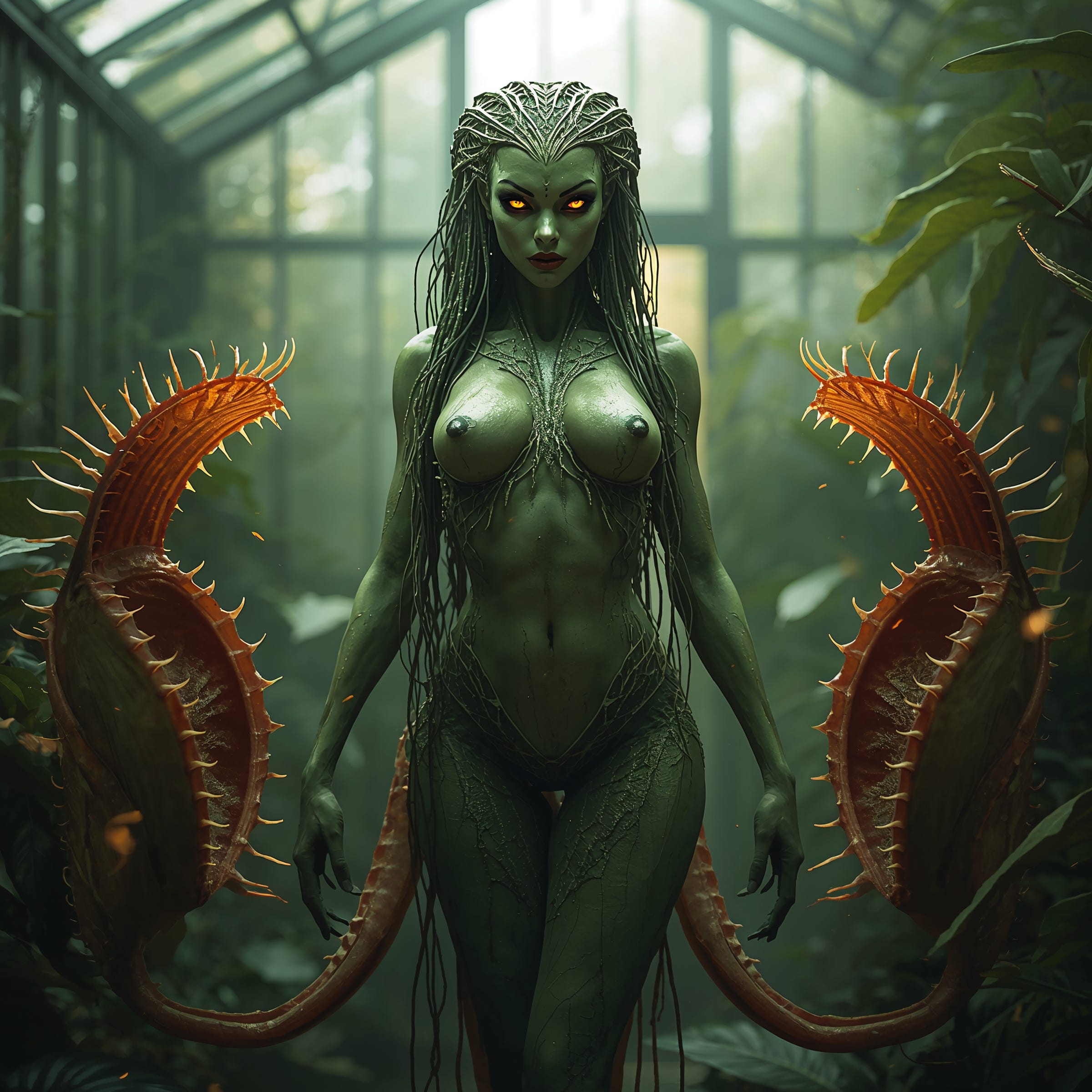
When she emerged fully, it was not sudden. The air thickened as she did, heavy with warmth and chlorophyll, every breath tasting faintly green. She told him her name was Xyra, shaping the sound carefully, as if translating it into something his mouth could hold. Nothing about her was abrupt. From the central stalk she shaped herself slowly, deliberately—shoulders first, then arms, a face framed by leaves like dark hair. Her skin had the faint sheen of a leaf after rain, layered in fine organic patterns like living armor, veins faintly luminous beneath the surface. Her eyes were deep and reflective, catching the light without quite giving it back.
She was beautiful in the way fire is beautiful. Heat radiated subtly from her, not burning but persistent, raising gooseflesh along his arms. Not human, but close enough to invite comparison.
From her back unfurled two vast, jointed stalks, living extensions of her spine. At their ends opened immense Venus flytrap petals, heavy and deliberate, each easily large enough to swallow a grown body whole, their ridged interiors glistening as they breathed. They were not rooted in the soil—they were part of her.
She learned his name before he thought to ask hers.
He learned quickly not to ask where she came from.
The fruit appeared as the days lengthened, not as growth but as birth.
She produced the fruit one at a time, drawing it from her body with care, pearlescent and warm in the hand, its skin humming faintly against his palm as if alive. She held each one briefly, almost reverently, before pressing it into Elias’s palm. “Eat,” she told him. He hesitated only once before tasting it, and even that hesitation felt performative. The flavor bloomed across his tongue—sweet without sugar, rich without weight, layered with something that felt like memory rather than taste. The greenhouse seemed to breathe with him, leaves shivering softly as his pulse slowed. Warmth spread through him, followed by a soft euphoria, a loosening behind the eyes that made the world feel briefly and profoundly right. He ate another. Then a third, slower this time, reverent.
Xyra watched him with quiet satisfaction. Something subtle passed between them then, a quiet alignment, as if a thought not entirely his own had found a place to rest.
The idea of baking came to him gently, fully formed, as if it had always been there. He baked with the fruit because baking was how he understood abundance.
He brought a pie to the county fair out of habit more than ambition. When it won—unanimously, to his mild shock—people gathered around his table, asking questions, asking for seconds, leaning closer without realizing why. He told them where the fruit came from.
“My garden,” he said.
He believed that was enough.
That night, someone broke into the greenhouse.
He heard the scream from the house—short, sharp, abruptly silenced. By the time he reached the barn, the glass was fogged from the inside, streaked with condensation and something darker.
The petals had closed. A wet, fibrous sound lingered in the air, followed by the sharp tang of sap and iron.
Two shapes were pressed within them, outlines against living flesh. The smell was green and metallic, threaded with something sweeter and alien—an otherworldly scent like crushed leaves, warm fruit, and ozone, impossible to place and impossible to forget. Xyra regarded him calmly, her expression softened by something he recognized as contentment,
“Why?” he asked, though the question felt fragile the moment it left him.
“I am what I am,” she said. “And they were hungry.”
His hands shook. He stared at the petals, at what remained of the intruders, at the soil beneath her darkened and rich. He thought of the fair. Of the way people’s eyes had lit up at the first bite. Of how desire moved faster than reason.
“Are you going to eat me too?”
She studied him for a long moment. A vine brushed his wrist, gentle, almost affectionate.
“Not today, love,” she said. “But I need you to keep making things with my fruit.”
Outside, the orchard slept. Inside, the air was heavy with heat, scent, and the slow sound of growth—soft creaks, faint pops, the language of plants expanding. Inside, something ancient and patient waited.
He closed the greenhouse door behind him and locked it from the outside.
In the days that followed, he deepened the soil and adjusted his recipes. He baked again. He learned how far the scent traveled, how it slipped between leaves and fences alike, how curiosity bloomed wherever it lingered. And he found himself loosening things he’d once tightened—an unlatched window, a lock left merely turned but not set, the greenhouse door not quite pulled flush. Small mercies, he told himself. Ventilation. Convenience. He told himself that everything that lived needed to feed, and that love was not always gentle.
Some things asked only that you tend them.
Some things asked that you understand what they are.
And some things, once planted, asked you to choose.
He chose.
If you would heart it, then share it…
For more Feburary Prompted content from Dblkrose of BSP…
Free is good, do so and I’ll bring the next one straight to your inbox.
Paid… well, that helps keeps the lights on.
or
Buy Me a Coffee ☕ to ease the strain.
&
Stop by www.blkspyder.com to check in on the Brand.
A man who loved plants learned too late that some things grow not to be harvested, but to be fed—and loved for what they are. #Dblkrose #BlkSpyderPublishing #DarkFantasy #Fiction #Alien #SpeculativeFiction #WeirdLit #BodyHorror
I absolutely love this! The atmosphere of this story is so vivid.
Oh my.