
The GraveMaw
The land remembers what we tried to bury.

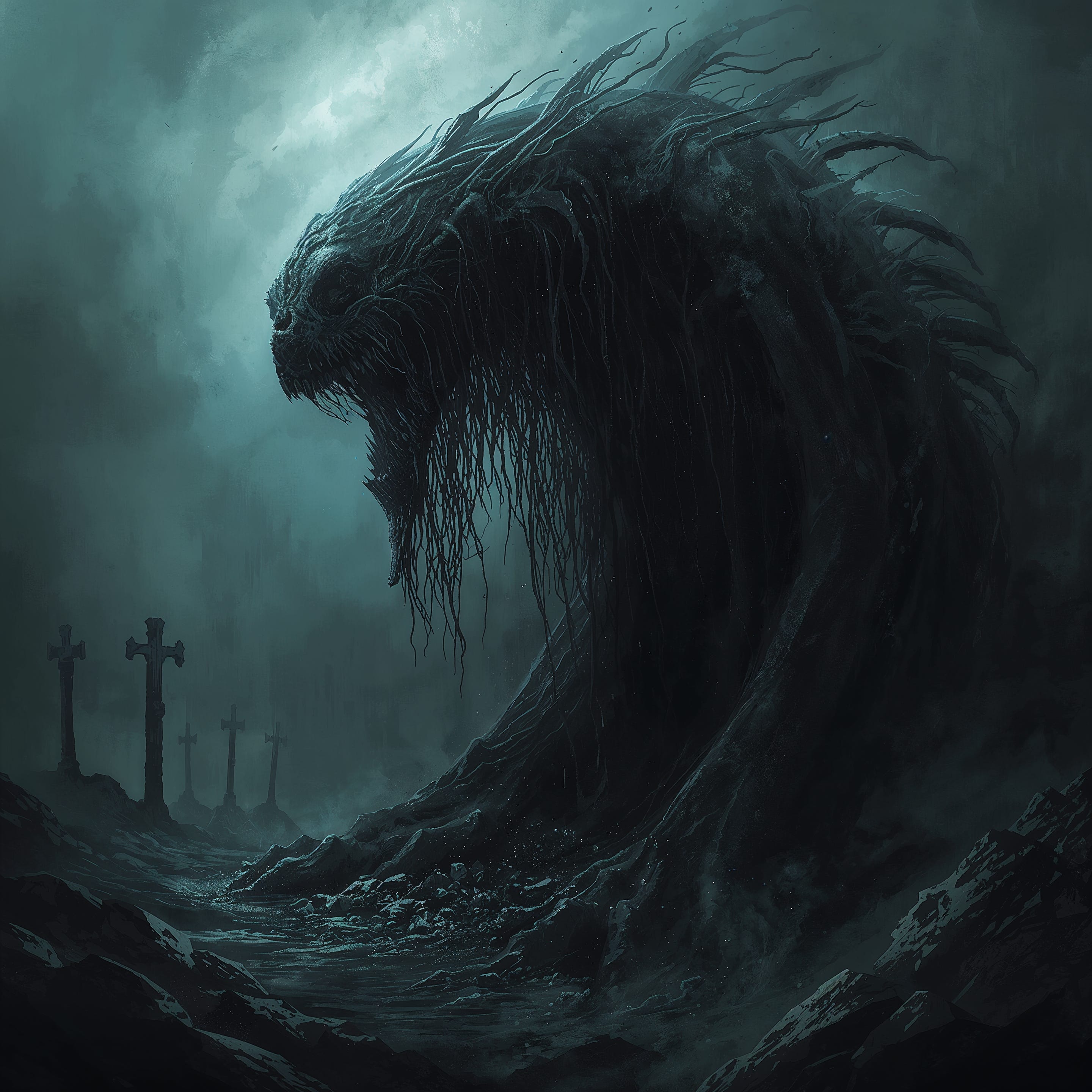
I should begin by stating, for the record, that this place does not wish to be written about.
The map called it a “disputed lowland.” The village elder in Dren’s Ford called it “the quiet field.” But when I crested the last frost-burned rise and saw the crosses standing in the fog, my first thought was:
Here. This is where the story was cut out of the world.
There are fifty-three markers by my count, though the mist makes them seem to multiply. Rough-hewn, uneven, driven into the earth at inconsistent depths as if the hands that placed them were in a hurry—or afraid.
None bear names.
No carved runes. No sigils of House or clan. No identifying glyphs of the Umbrin, whose entire people I’ve been tasked with cataloging in absence.
The genocide has left me chasing ghosts through burned archives and half-remembered songs. Here, for the first time, the ghosts seem to have congealed into something almost physical: lines of anonymous wood over a swollen patch of ground.
The soil between the markers is wrong. It swells and sags in places, like a badly stitched wound. The grass grows darker here, more like hair than plant. When the wind runs through it, it makes a sound like whispering parchment.
I set up my small camp at the edge of the field—journal, charcoal, bone dividers, and the brass sphere that records ambient aetheric residue for later study. The device began to hum the moment I opened it, picking up… something. Too much, perhaps.
Preliminary notes, before the light fails:
No animal tracks within twenty paces of the first marker. The snow outside the boundary is crisscrossed by hare, fox, crow. Inside, nothing. The silence is curated.
The air is colder between the crosses, though my breath steams the same.
Standing between them, I feel watched, though there are no crows on the wood, no trees on the horizon.
I knelt and pressed my palm to the ground.
The chill that seeped into my bones did not feel like simple winter. It felt… crowded.
My tutors at the Collegium used to say that the dead are quiet if laid to rest properly. Ritual smooths their passage, like oil on hinges. But the Umbrin were denied rites, denied names, denied even the acknowledgement of their erasure.
Unresolved death. An entire people reduced to a rumor and an empty page.
If there is a god listening, this would be where it clenches its teeth.
I began to sketch the layout: marker distances, soil discoloration, direction of prevailing wind, any carvings or tool marks on the wood. My charcoal seemed to dull faster than usual, as if the page resisted taking the impression of this place.
At some point, I realized the fog was thickening, not thinning, as evening settled. It banked low along the ground, curling around the bases of the crosses, pooling in the shallow depressions between them.
And then I heard voices.
I extinguished my lantern immediately and slipped behind one of the larger stones at the edge of the rise. From there, I had a clear line of sight down into the field.
Two men, by their silhouettes. Heavy cloaks, travel-stained. One carried a shovel over his shoulder; the other dragged a canvas sack that clinked with the soft, ugly music of metal on metal.
Grave-robbers.
The thought tasted sour.
“See?” the taller one said, his voice too loud in the still air. “Told you no one comes out here. Just old war dead. No one cares ‘bout them.”
“War dead fetch curses,” the other muttered, but he set the sack down and began to scrape at the soil between two of the nameless crosses. “You sure there’s anything worth the trouble?”
“Bodies always got something. Rings. Teeth. Charms. You’re getting skittish as a priest.”
They laughed. It grated. Every word felt like a boot on a throat.
Part of me wanted to reveal myself, to shout them away on the authority of the Crown’s commission. But another part—older, colder—told me to stay very, very still.
The fog had stopped moving.
I realized it as he drove the shovel in again. The mist no longer curled or eddied; it hung, dense and heavy, clinging close to the ground, as if the air itself had decided to hold its breath.
The brass sphere in my satchel began to buzz against my hip, picking up a surge in aetheric interference so strong I could feel it through the leather.
The shovel struck something that was not stone.
“Ha,” the taller one grunted, kneeling to scrape with his bare hands. “Knew it. Hear that? That hollow sound? Coffin or bone box, maybe. Least the bastards buried ‘em proper out here.”
“Don’t say ‘bastards’ in a graveyard,” the other whispered.
“They’re dead. They don’t care.”
The ground did not agree.
At first I thought my eyes were playing tricks on me. The line of soil he’d disturbed seemed to… sink. Not like a collapse or a cave-in—more like exhalation. The entire patch between the markers relaxed, as if it had been clenching for a long time.
Then it began to rise.
Not in a single swell, but in ripples—as if something far below was pushing upward in slow, horrible waves. The crosses tilted and straightened, tilted again, their silhouettes stuttering against the dim sky.
The men noticed only when the shovel slid away from his hand, swallowed by the earth without a sound.
“What—?” he started, reaching after it.
The soil caught his wrist.
I must be precise here: it did not “grab” him in the way a hand might. Rather, the ground around his arm liquefied and then clung, thick and black and viscous, like wet roots and grave mud braided together. It crawled up his sleeve with unsettling purpose.
He screamed and tried to wrench back, but the more he struggled, the more the earth climbed him.
The smaller man staggered back, eyes wide. “Cut it loose!” he yelled, fumbling for a knife. “Gods, just cut—”
He never finished.
The swell that had been building between the rows of markers finally broke.
The land rose up, not vertically but in a terrible, cresting arc—soil and stone and root and something else, something darker, all fusing together into a shape that mocked the idea of a wave. It towered over the crosses, over the men, over me, a shadow with weight.
It had the vague form of a head, if a head had been conceived by a nightmare: no clear features, just hollows where eyes might once have been and a vast, sloping maw fringed with dangling roots like a beard of nerves.
I could not move. Every instinct screamed at me to flee, but the scholar in me, damn her, insisted on witnessing.
The Grave Maw—there is no other term that fits—bent toward the trapped man. Its “mouth” opened, not along a hinge but along a series of cracks in its mass, earth splitting wide to reveal a darkness that wasn’t merely absence of light, but absence of permission.
The scream that followed did not come from the man.
It came from everywhere.
It was the sound of a thousand unsaid names trying to be spoken at once.
The smaller robber turned to run. The ground ahead of him bulged and tore, slick with mud and roots, and he vanished up to the waist in a heartbeat, limbs flailing as he was dragged under by the same clinging, sentient soil. His knife flashed once in the fog and then was gone.
The Grave Maw did not chase them. It did not thrash or roar. It simply leaned, and the earth obeyed, folding and consuming with the mindless inevitability of a closing book.
Within moments, both men were gone.
The disturbed soil sank again, smoothing itself with a slow, almost tender finality. The crosses straightened. The fog loosened, resuming its gentle drift as if some long-held breath had finally been released.
Silence returned—not the simple absence of sound, but a curated, deliberate quiet.
My hands were shaking so badly I nearly dropped my journal when I opened it.
Observations, as best as I can render them through the tremor:
The Grave Maw is not a discrete creature in the conventional sense. It is the land itself, animated by accumulated, unacknowledged death. A localized geological will.
It responded not to my presence, but to the desecration—the intent to plunder. This suggests a behavioral pattern: protective, not predatory. It is an immune response, not a hunter.
Its manifestation coincided with a surge in aetheric activity strong enough to overload a calibrated recording sphere. There is power in unresolved memory. More than we have accounted for.
It left me untouched. Observer is tolerated; violator is not. This distinction matters.
I am an archivist. My work is to record, to name, to give shape to what is at risk of disappearance. I have spent years chasing traces of the Umbrin through burned documents and altered histories, trying to prove that a people erased still mattered.
Tonight, the land itself made the same argument for me—in a language of earth and terror.
They are not gone.
They are unresolved.
And the world will not swallow that quietly forever.
At dawn, I will return to the field proper. I will not dig. I have learned that lesson secondhand. But I will walk between the markers and speak aloud every Umbrin name I have salvaged from the archives.
The dead here deserve more than anonymity. They deserve to be remembered as something other than a trigger for the earth’s rage.
If the Grave Maw is the land’s retaliation for forced forgetting, then perhaps my task is not just to catalog the genocide—but to relieve some of that pressure, to offer the world another way to let the truth surface.
For now, I will close this entry with a simple, cowardly admission:
I am terrified.
And yet, for the first time since I began this work, I do not feel alone.
If you would heart it, then share it…
For more Forgotten Grave content from Dblkrose of BSP…
Free is good, do so and I’ll bring the next one straight to your inbox.
Paid… well, that helps keeps the lights on.
or
Buy Me a Coffee ☕ to ease the strain.
&
Stop by www.blkspyder.com to check in on the Brand.
An exhausted archivist discovers that some graves are meant to be remembered, never disturbed. #Dblkrose #BlkSpyderPublishing #DarkFantasy #Fiction #HorrorStory #GraveMaw #DarkLore #IndieAuthor
Anyone can write a good story. Some of us can create a great story. But to create lore in your story—a new god for the pantheon or a monster to be wary of—that is a rare gift. You, my friend, have achieved this. I take my hat off to you. Great job!
This wrapped me in its foggy grayness as the words rose and fell in gothic ambience.